Overview
I built a system that suggests books a reader is likely to enjoy based on how people have rated books in the past.
- With online retail growing, personalized recommendations drive discovery, engagement, and sales for book retailers.
- Most user-book pairs are unrated, so the goal is to predict which unseen books a user would rate highly.
- Objective: build and compare recommenders that turn sparse rating data into a ranked top-N book list per user.
- Also address the cold-start problem of recommending to brand-new users with no rating history.
Methodology
flowchart LR
  A["User-Item Ratings"] --> B[EDA & Filtering]
  B --> C["Approaches: Popularity / Collaborative Filtering / SVD"]
  C --> D["Evaluate: RMSE / Precision@K"]
  D --> E[Top-N Recommendations]
The Data: Users, Books & Ratings
I started with over a million book ratings and cleaned them down to the meaningful ones before modeling.
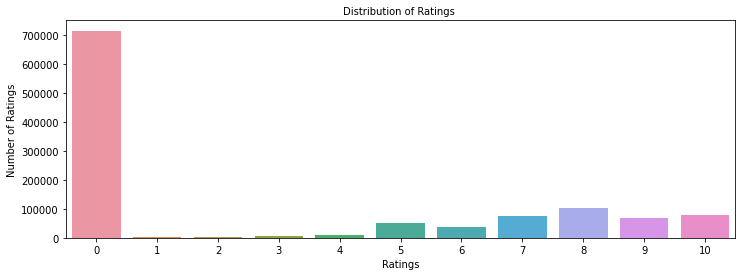
- Merged ratings and book datasets into 1,149,780 observations across 7 columns of user, book, and rating fields.
- Ratings use a 1-10 scale; rating '0' dominated (~700K) and was treated as missing, then dropped.
- After removing the 0 ratings, 433,671 genuine ratings remained from 77,805 users across 185,973 unique books.
- Matrix is extremely sparse: only 433,671 of a possible ~14.5 billion user-book interactions are filled in.
Exploratory Analysis
I explored how ratings are spread out and found that a few popular books get most of the attention.
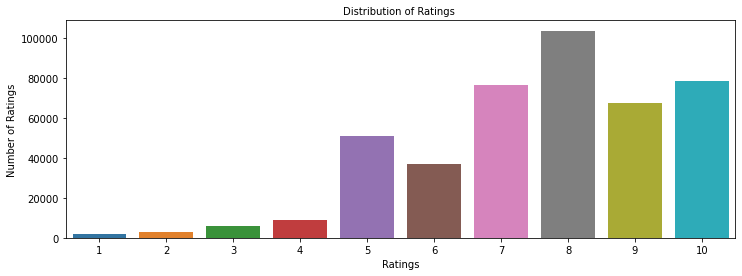
- After cleaning, rating 8 was most common (~100K), followed by ratings 10 and 7 (~80K each); ratings 1-4 were rare.
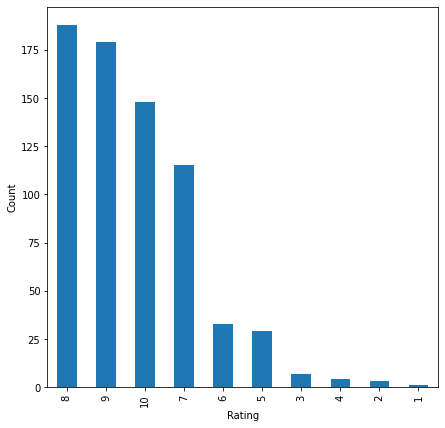
- Most-reviewed book (bookid 0316666343) drew 707 users, and was rated 8/9/10 by the majority who read it.
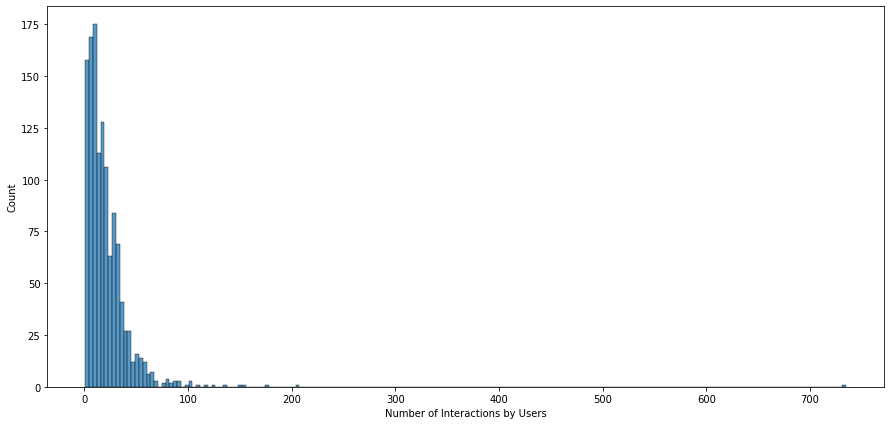
- Power user 11676 rated 8,524 books, showing a small set of very active raters drives much of the data.
- User-book interaction counts are heavily right-skewed: very few books have many ratings, most have few.
Recommender Approaches
I tried four methods, from a simple popularity ranking to advanced models that learn hidden user and book patterns.
- Model 1 - Rank-based: recommends most popular books by average rating with a minimum-interactions threshold, solving cold start.
- Model 2 - User-user collaborative filtering: cosine similarity with KNN to find like-minded users (scikit-surprise KNNBasic).
- Model 3 - Item-item collaborative filtering: similarity computed between books rather than between users.
- Model 4 - Matrix factorization (SVD): learns latent user and book features; all models tuned via GridSearchCV.
- Evaluated with RMSE plus precision@k and recall@k, using rating 7 as the relevance threshold.
Results & Recommendations
Tuning improved every model, and item-based filtering gave the most accurate rating predictions.
- Baseline user-user CF: RMSE 1.84 with ~0.81 precision and recall; tuning cut RMSE to 1.68 and raised F1 from 0.81 to 0.86.
- Item-item CF was strongest on accuracy: RMSE improved from 1.62 to 1.58 with F1 around 0.80 after tuning.
- Matrix factorization (SVD) F1 beat the user-user baseline but tuning yielded only marginal further gains.
- Validated predictions case by case (e.g. user 1326, book 12344 predicted ~7.99 vs actual 8) and applied corrected ratings to rank ties.
Key Takeaways
Combining a simple popularity baseline with personalized models gives reliable book recommendations even from very sparse data.
- Rank-based recommendations are a cheap, robust fallback for new users facing the cold-start problem.
- Personalized collaborative filtering and matrix factorization clearly outperform popularity once a user has history.
- Hyperparameter tuning with GridSearchCV consistently lowered RMSE and raised F1 across all model families.
- Corrected ratings that weight the number of raters produce more trustworthy top-N rankings than raw averages.
- Built with: pandas, numpy, matplotlib, seaborn, scikit-learn, scikit-surprise
Tech Stack
- pandas — data wrangling and tabular manipulation
- numpy — fast numerical arrays
- scikit-learn — modeling, pipelines, and evaluation
- seaborn — statistical visualization
- matplotlib — plotting
- scikit-surprise — collaborative-filtering recommenders
Attribution
This project was completed as part of the MIT Applied Data Science Program (MIT IDSS / Great Learning). The program provided the case-study scaffolding; the analysis, code, and results are my own. Published with permission, for portfolio use only.