Overview
We want to guess what topic a research paper is about by looking at which other papers it cites.
- Goal: classify each scientific publication into one of 7 research topics using node classification on a citation graph.
- Standard ML treats each paper independently; here the citation links between papers carry signal we want to exploit.
- A Graph Neural Network learns each node's representation from its own words AND its cited/citing neighbors.
- Only 140 of 2,708 papers are labeled for training, so the model must generalize from a tiny labeled fraction.
- Stretch task: link prediction — given two papers, predict whether a citation edge should exist between them.
Methodology
flowchart LR
  A["Graph: Nodes + Edges"] --> B[Node Features]
  B --> C["Graph Neural Network layers"]
  C --> D[Train]
  D --> E["Evaluate: Node-Classification Accuracy"]
The Data (Citation Graph)
The data is a web of 2,708 papers connected by who cites whom, with each paper described by the words it uses.
- Cora dataset: 2,708 scientific publications (nodes) linked by 5,429 citation relationships across 7 topic classes.
- Each paper is a 1,433-length binary word vector: a 1 where a dictionary word is present, 0 where absent.
- Citations are directional (a paper cites an earlier one) and there are no self-loops — a paper cannot cite itself.
- Loaded via DGL's CoraGraphDataset, which exposes 10,556 directed edges and per-node feature/label tensors.
- Pre-split into 140 training, 500 validation, and 1,000 test nodes via boolean masks on the single graph.
Graph Construction
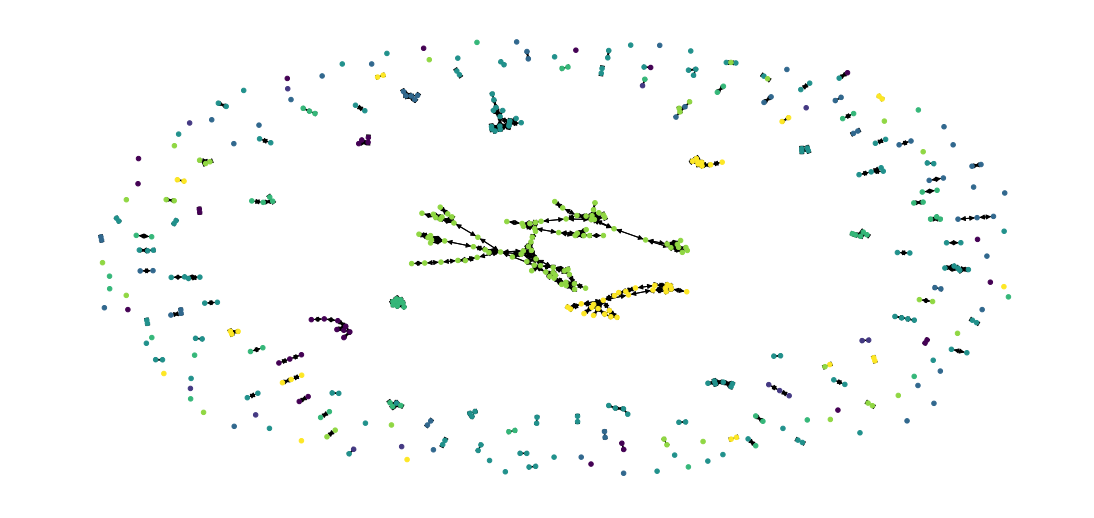
We turn the papers and citations into a graph the computer can read, then draw a slice of it to see the structure.
- The dataset is a single DGLGraph: nodes hold 1,433-dim features plus labels and train/val/test masks; edges encode citations.
- An adjacency view is a 2,708 x 2,708 matrix with an entry wherever one paper cites another (directional, no diagonal).
- Visualization converts a 500-node subgraph to NetworkX and colors each node by its topic label to reveal clustering.
- Graph convolutions pull information along edges, so a paper's neighbors directly shape its learned representation.
- For link prediction, 10% of real edges are held out as positive test cases and matched with sampled non-edges as negatives.
GNN Model
The model blends each paper's words with its neighbors' information over two passes, then picks the most likely topic.
- GCN architecture: GraphConv (1,433 -> 512), LeakyReLU(0.2), Linear (512 -> 512), LeakyReLU, GraphConv (512 -> 7).
- DGL's GraphConv layer handles message passing — aggregating and transforming features from each node's neighbors.
- Trained with Adam (lr=0.003, weight_decay=1e-3) for 100 epochs using cross-entropy on only the 140 training nodes.
- Validation accuracy is tracked each epoch to checkpoint the best model and report its corresponding test accuracy.
- Link-prediction variant swaps in two GraphSAGE (mean) layers plus a dot-product scorer over node embeddings.
Results
From just 140 labeled papers the model correctly identifies the topic of about 4 out of 5 unseen papers.
- Node classification reaches a best test accuracy of ~80.6% (validation ~80.6%) on the 1,000 held-out papers.
- Accuracy climbs fast — from ~9% to ~80% within the first ~25 epochs — showing the graph signal is highly learnable.
- Only 140 labeled nodes (5% of the graph) were needed, demonstrating the label efficiency of graph convolutions.
- Link prediction with GraphSAGE + dot-product scoring achieves an AUC of 0.87 on held-out citation edges.
- Both tasks confirm that citation structure, not just word content, carries strong predictive signal.
Key Takeaways
Connections between papers are powerful predictors, and graph neural networks turn those connections into accurate guesses.
- Graph convolutions let a model learn from relationships, not just isolated feature vectors — ideal for networked data.
- A compact 2-layer GCN generalizes well from very few labels by propagating information across citation edges.
- The same node embeddings support multiple tasks: topic classification (~80.6%) and link/edge prediction (AUC 0.87).
- Approach transfers directly to social, recommendation, and knowledge-graph problems framed as node or link prediction.
- Built with: DGL, PyTorch, NetworkX, scikit-learn, NumPy, and Matplotlib.
Tech Stack
- numpy — fast numerical arrays
- scikit-learn — modeling, pipelines, and evaluation
- matplotlib — plotting
- torch — deep-learning framework
- dgl — graph neural networks
- networkx — graph / network analysis
- scipy — scientific computing
Attribution
This project was completed as part of the MIT Applied Data Science Program (MIT IDSS / Great Learning). The program provided the case-study scaffolding; the analysis, code, and results are my own. Published with permission, for portfolio use only.