Overview
We built a model that estimates how many days a patient will stay so the hospital can plan beds and staff in advance.
- Poor allocation of beds, ventilators, and staff causes complications, a risk made vivid during the COVID-19 pandemic.
- HealthPlus hired us to find what drives length of stay (LOS) and predict it from data captured at admission.
- Accurate LOS forecasts let management pre-position resources, smooth patient flow, and reduce costly bottlenecks.
- Goal: identify the strongest LOS drivers and deliver an interpretable, statistically valid prediction model.
Methodology
flowchart LR
  A[Raw Data] --> B[Clean & Encode]
  B --> C[EDA]
  C --> D[Train/Test Split]
  D --> E["Random Forest / Linear Regression / Ridge / Lasso"]
  E --> F["Tune (Cross-Validation)"]
  F --> G["Evaluate: R2 / RMSE"]
The Data
We started with half a million admission records, each describing a patient and their hospital visit.
- Dataset of 500,000 patient admission records across 15 columns, with no missing values and all rows unique.
- Mix of numeric fields (extra rooms, staff available, visitors, admission deposit, stay) and categorical fields.
- A single patient was admitted up to 21 times; on average ~3 rooms and ~5 staff were available per admission.
- About 82% of patients arrive with moderate or minor illness; gynecology receives ~68% of all patients.
- Target variable is Stay (in days), available only after admission and a few tests.
Exploratory Analysis
We looked at how long patients typically stay and how the main numeric factors are distributed.
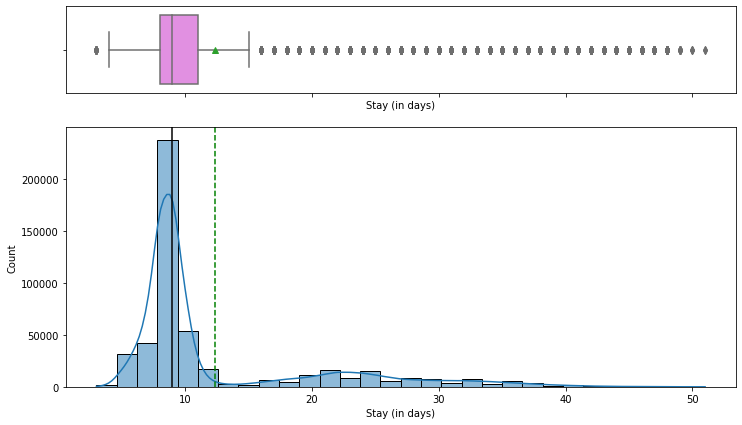
- Most patients stay 8-9 days; few stay beyond 10 days and very few beyond 40, matching the mild-illness mix.
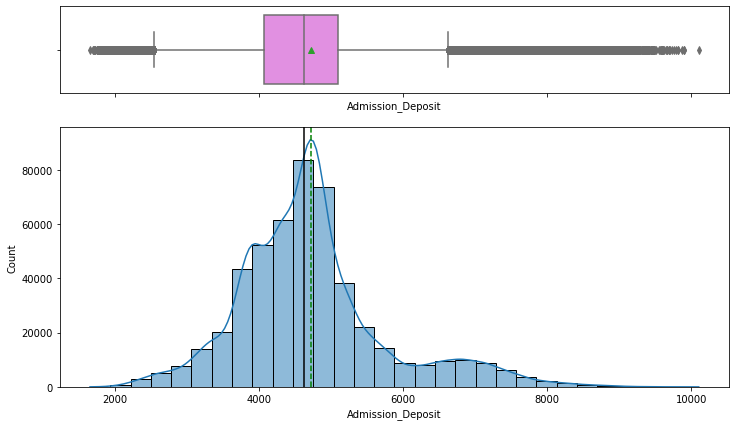
- Admission deposit is roughly normally distributed with outliers paying unusually high or low fees.
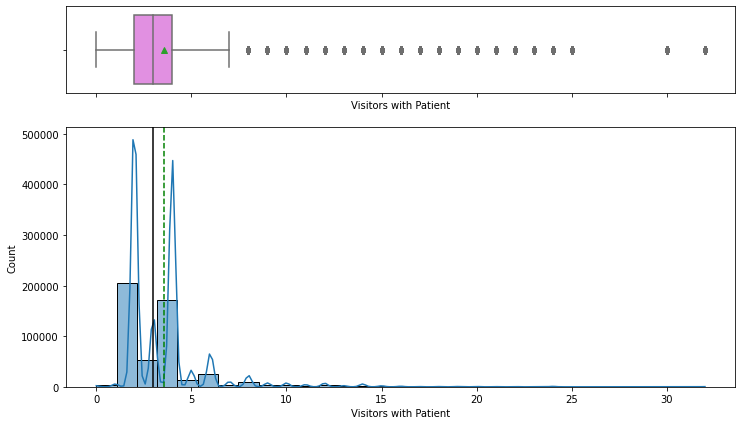
- Number of visitors is highly right-skewed, with 2 and 4 being the most common visitor counts.
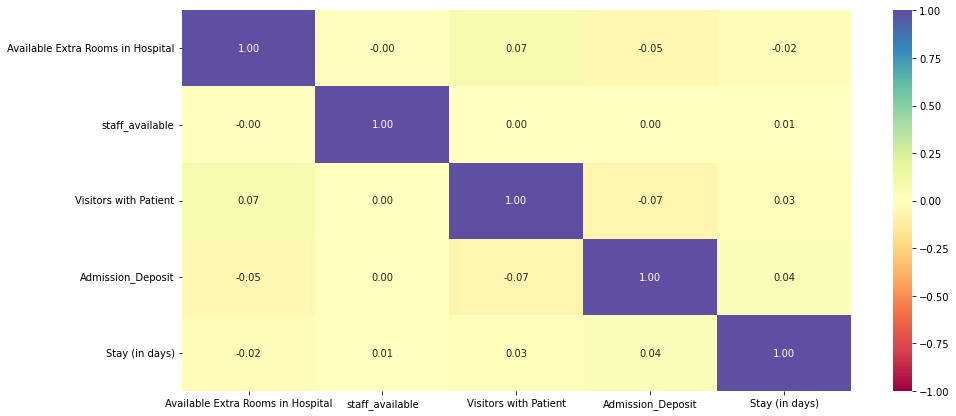
- Correlation heatmap shows almost no correlation among numeric features or with LOS.
- Weak numeric correlations signaled that categorical features (ward, department, severity) would drive prediction.
Key Drivers of Length-of-Stay
Stay length is shaped mostly by which ward and department a patient is in, plus illness severity and age.
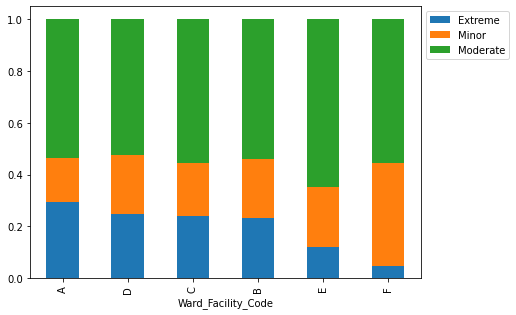
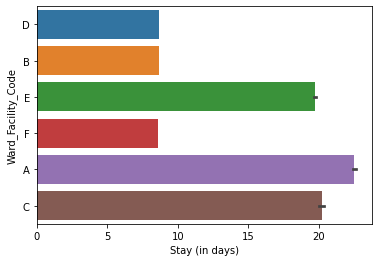
- Wards A and C have the longest stays, suggesting they handle the most serious cases.
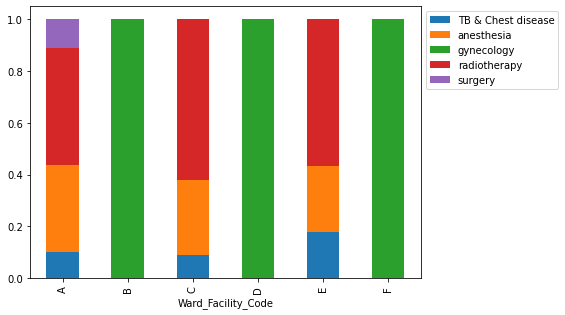
- Ward A holds the most extreme cases and the only surgery patients, demanding more staff and resources.
- Wards B, D, and F are dedicated to gynecology; A, C, and E cover all other diseases.
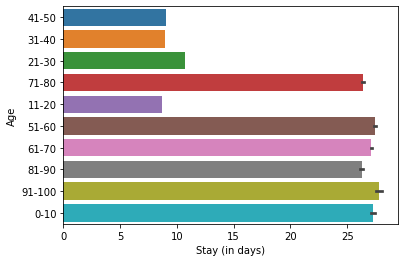
- Patients aged 1-10 and 51-100 stay longest, while the 21-50 group skews toward shorter gynecology stays.
- 9 doctors staff the hospital, with 4 in high-volume gynecology; Dr. Sarah and Olivia treat the most patients.
Modeling & Results
A linear regression model predicts stay within about two days, and adding complexity did not improve it.
- Linear Regression reached an adjusted R-squared of ~0.84, explaining 84% of variance in length of stay.
- Mean Absolute Error of ~2.15 days on test data, with train and test metrics close, so no overfitting.
- Ridge, Lasso, and Elastic Net (tuned via GridSearchCV) gave no improvement over ordinary least squares.
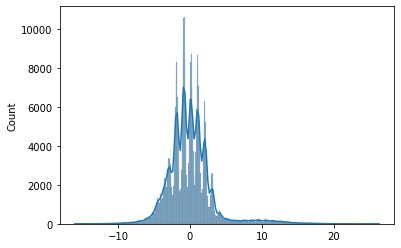
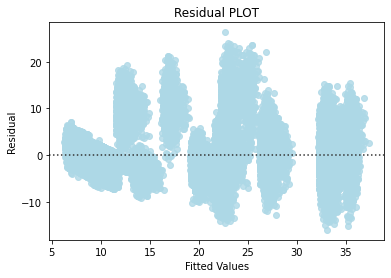
- All linear regression assumptions held: zero-mean normal residuals, linearity, and homoscedasticity.
- Forward feature selection cut features from 42 to 8 (~81% fewer) while keeping R-squared at 0.840.
Key Takeaways
We delivered an accurate, easy-to-explain LOS model and pinpointed the few factors that matter most.
- LOS can be predicted at admission within ~2.15 days, supporting proactive bed and staff planning.
- Ward, department, severity, and age are the dominant drivers; numeric variables add little signal.
- A simple 8-feature linear model matches the full model, easing deployment, storage, and interpretation.
- Verified statistical assumptions make the model trustworthy for inference, not just prediction.
- Built with: pandas, numpy, matplotlib, seaborn, scikit-learn, statsmodels, mlxtend
More Visualizations
Tech Stack
- pandas — data wrangling and tabular manipulation
- numpy — fast numerical arrays
- scikit-learn — modeling, pipelines, and evaluation
- seaborn — statistical visualization
- matplotlib — plotting
- statsmodels — OLS / statistical inference & VIF
Attribution
This project was completed as part of the MIT Applied Data Science Program (MIT IDSS / Great Learning). The program provided the case-study scaffolding; the analysis, code, and results are my own. Published with permission, for portfolio use only.